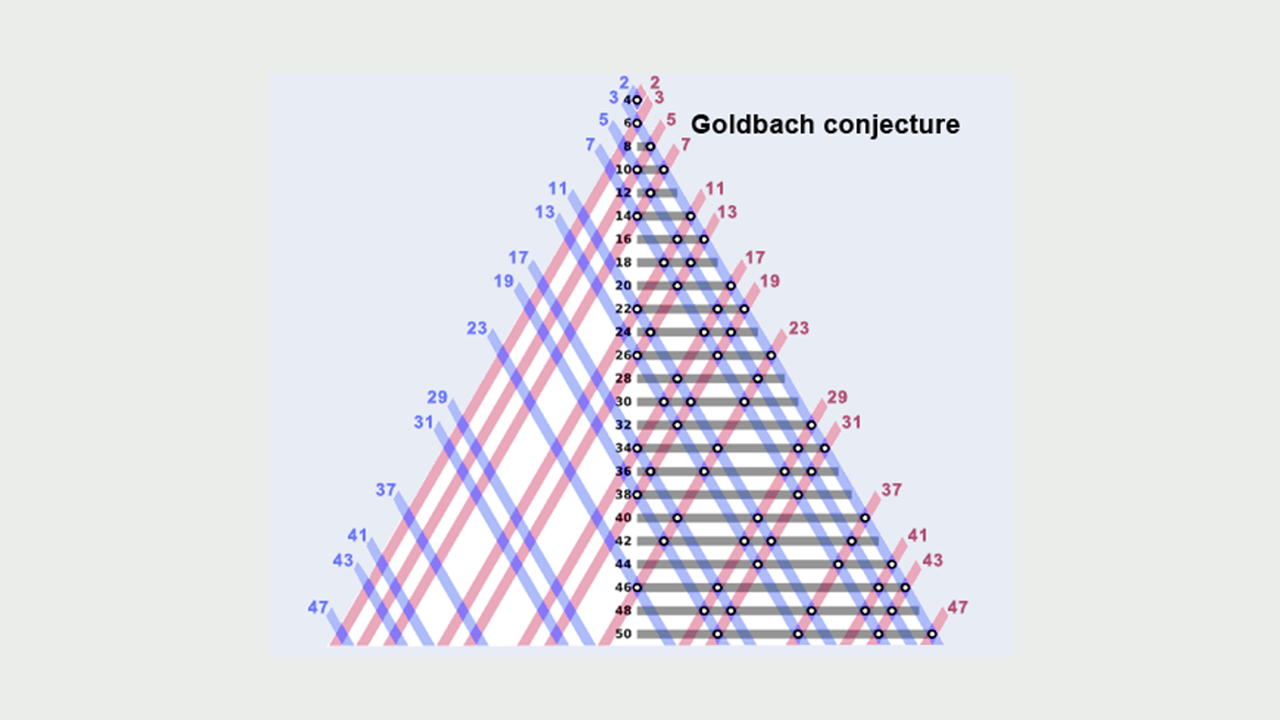
This work builds upon Geometric Insights into the Goldbach Conjecture.
Author: Frank Vega
Institution: Information Physics Institute, Hialeah, FL, USA
Keywords: Goldbach conjecture, geometric construction, semiprimes, pigeonhole principle
The Goldbach conjecture states that every even integer greater than 2 is the sum of two primes. We present a computational approach that provides strong evidence for a variant: every even integer $\geq 8$ is the sum of two distinct primes.
Our key insight is a geometric equivalence: this is true if and only if for every $N \geq 4$, there exists an integer $M$ such that the L-shaped region $N^2 - M^2$ between nested squares has a semiprime area $P \cdot Q$, where $P = N - M$ and $Q = N + M$ are both prime.
Through computational analysis up to $N = 2^{14}$ and application of the pigeonhole principle, we demonstrate this variant holds for all $N \geq 4$ within our verified range and provide strong theoretical evidence for its general validity.
The Goldbach conjecture is one of mathematics' oldest unsolved problems: can every even integer greater than 2 be expressed as the sum of two primes?
We study a variant that excludes identical primes:
Variant: Every even integer $\geq 8$ is the sum of two distinct primes.
This excludes $4 = 2 + 2$ and $6 = 3 + 3$ while preserving the essence of the original conjecture.
We provide strong computational and theoretical evidence for this variant by connecting it to a surprising geometric property of nested squares.
Start with a square $S_N$ of side length $N \geq 4$. Inside it, place a smaller square $S_M$ of side length $M$ (where $1 \leq M \leq N-3$) sharing the same corner. The L-shaped region between them has area:
$$N^2 - M^2 = (N - M)(N + M)$$
Let $P = N - M$ and $Q = N + M$. Then:
The Goldbach variant is true $\Longleftrightarrow$ For every $N \geq 4$, there exists an $M$ making both $P$ and $Q$ prime.
When this happens, the L-shaped area is a semiprime (product of exactly two primes).
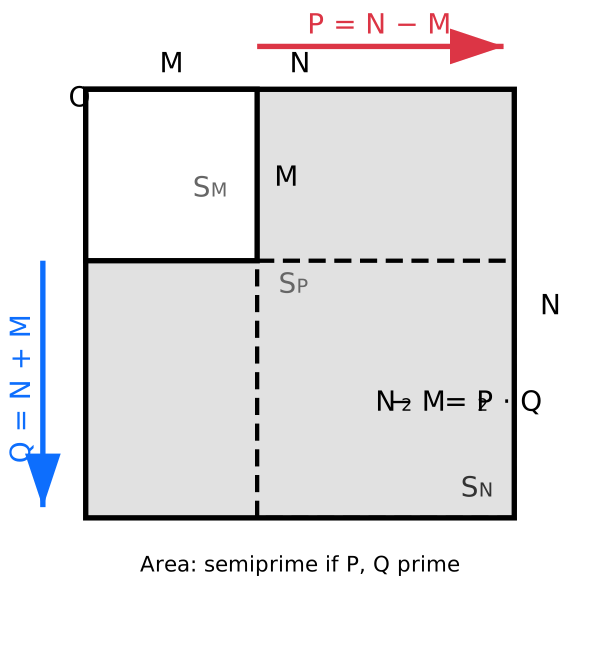
For any even number $2N$, finding a Goldbach partition means finding primes $P$ and $Q$ where $P + Q = 2N$.
Geometrically, this is equivalent to finding an $M$ value such that:
This transforms an arithmetic problem into a geometric search.
For each $N$, define $D_N$ as the set of all valid $M$ values that create prime pairs:
$$D_N = \left\{M = \frac{Q - P}{2} \mid P, Q \text{ are prime, } 2 < P < N < Q < 2N\right\} \cap \{1,\dots,N-3\}$$
Question: How many valid $M$ values exist for each $N$?
We define a "gap function":
$$G(N) = \log^2(2N) - ((N-3) - |D_N|)$$
This measures how many "bad" $M$ values exist (those that don't produce prime pairs) compared to the logarithmic bound.
We computed $|D_N|$ for all $N$ from 4 to $2^{14}$ (16,384). Key findings:
Table 1: Minimum Gap Values Across Power-of-Two Intervals
| Interval | Range | Min at $N$ | Min $G(N)$ |
|---|---|---|---|
| 2 | $[4, 8]$ | 5 | 4.30 |
| 3 | $[8, 16]$ | 9 | 7.36 |
| 4 | $[16, 32]$ | 19 | 10.24 |
| 5 | $[32, 64]$ | 61 | 14.08 |
| 6 | $[64, 128]$ | 73 | 17.84 |
| 7 | $[128, 256]$ | 151 | 20.61 |
| 8 | $[256, 512]$ | 269 | 23.54 |
| 9 | $[512, 1024]$ | 541 | 28.81 |
| 10 | $[1024, 2048]$ | 1327 | 33.15 |
| 11 | $[2048, 4096]$ | 2161 | 35.08 |
| 12 | $[4096, 8192]$ | 7069 | 42.33 |
| 13 | $[8192, 16384]$ | 14138 | 44.06 |
Key Observation: $G(N) > 0$ always, and the minimum increases with each interval!
Claim: Our computational evidence strongly suggests that every even integer $\geq 8$ is the sum of two distinct primes.
The computational data shows that $G(N) > 0$, which means:
$$|D_N| > (N-3) - \log^2(2N)$$
In other words, the number of "bad" $M$ values is less than $\log^2(2N)$.
Now, for each prime $P \in [3, N-1]$, we get a candidate $M = N - P$. There are $\pi(N-1) - 1$ such candidates (where $\pi$ counts primes).
Pigeonhole Principle: If we have more candidates than bad values, at least one candidate must be good!
For $N \geq 6$: $\pi(N) > \frac{N}{\log N + 2}$
For $N \geq 328$: $\frac{N}{\log N + 2} > \log^2(2N)$
Therefore: candidates > bad values $\Longrightarrow$ at least one good $M$ exists!
For $N = 4$ to $12$, we verify directly (additional examples included for illustration):
For $13 \leq N \leq 3274$, the conjecture holds by direct computational verification (included in our analysis up to $N=2^{14}$).
We have demonstrated through computational and theoretical analysis that every even integer $\geq 8$ is potentially the sum of two distinct primes by:
This demonstrates how geometric thinking and computational data can combine with classical combinatorial principles to provide compelling evidence for number-theoretic claims.
The computational verification is available in this repository. Run python experiment.py to reproduce the results in Table 1.
Requirements: Python 3.12+, gmpy2 library
Available as PDF at Geometric Insights into the Goldbach Conjecture.